Florio Family’s Move to Palermo
The Florios of SicilyThe Florio Family’s Move to Palermo is both a family migration and the decisive opening of a new commercial life. After an earthquake intensifies his fear for Vincenzo’s safety, Paolo declares that Bagnara no longer offers enough for his family or his ambitions. Palermo promises opportunity through the Florios’ existing spice business, but the move is not a shared beginning: Giuseppina resists, and as the boat approaches the harbor her gaze remains fixed on the home and relationships she has left behind.
Causes and Background
Paolo’s decision follows an earthquake that makes the danger of the family home immediate. He does not want Vincenzo to grow up under the threat of the house collapsing on him, but the safety of his child is only one reason. Paolo has been considering departure for a long time; now he says that the village and the life it permits are no longer enough. His chosen destination is Palermo, where he sees the possibility of a larger future.
That future is already taking shape through trade. A couple of years earlier, Paolo and his brother Ignazio had established a small warehouse in Palermo, a fondaco for goods bought along the coast and later sold around the island. What began as a practical storage point became an emporium when Paolo recognized that the brothers could enlarge their sales in one of the Mediterranean’s major ports. The move therefore builds on an enterprise already in motion rather than beginning from nothing. A substantial community of people from Bagnara also lives in Palermo, while the arrival of the Bourbons fleeing revolution has helped make the city wealthy and full of prospects.
The economic setting extends beyond the brothers’ own warehouse. Spices reach European counters through long, costly chains of transport: they pass through many hands, travel overland by mule or camel, cross the sea, and arrive at ports. Their uses range from cooking to medicine, cosmetics, and poisons, making them valuable goods for both sellers and the comparatively few buyers who can afford them. At the beginning of the nineteenth century, British and French merchants have displaced Venice as the leading sellers; their ships bring spices and other colonial goods, including sugar, tea, coffee, and chocolate. As prices fall, markets diversify, and harbors open, Palermo’s spice trade expands. Its aromatari have their own guild and church, Sant’Andrea degli Amalfitani, while the number of people able to enter the business grows.
The Household Breaks Apart
The move is announced first as a private decision between brothers. When Paolo tells Ignazio that he wants to leave Bagnara, Ignazio hopes he has misunderstood. Mattia and Paolo have long supported him; Mattia now has a family of her own, and the thought of Paolo leaving produces a fear of abandonment. The brothers are not simply weighing two places. For Ignazio, Palermo threatens to take away the family companionship on which he has relied.
Giuseppina’s response makes the household conflict explicit. Paolo explains that he and Barbaro opened the aromateria in Palermo, that the city is wealthy, and that people from Bagnara live near its harbor, so she would not be alone. He approaches her and strokes her arm in an awkward gesture intended as kindness. She shakes off his hand and refuses to come. Paolo answers not by persuading her but by asserting his authority as her husband: she will go with him, even if he has to drag her by the hair to King Roger’s Tower. He orders her to pack and sets their departure for the end of the following week. The migration thus exposes the unequal power within the marriage: Giuseppina’s refusal is heard, but it does not determine whether she must leave.
Arrival and Two Different Palermos
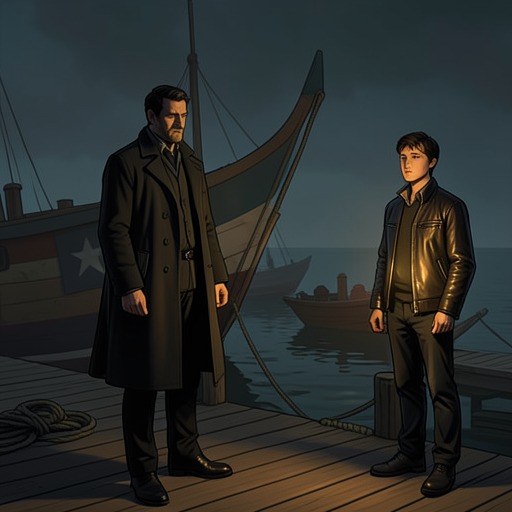
The decision’s emotional reversal comes when the brothers’ skiff reaches sight of Palermo’s harbor. Ignazio recognizes the familiar pang in his stomach, smiles, and squeezes Paolo’s arm; Paolo returns the gesture. Ignazio is happy to be coming with his brother, not being left behind in Bagnara. His excitement makes the city a promise of shared life as well as a place to conduct business.
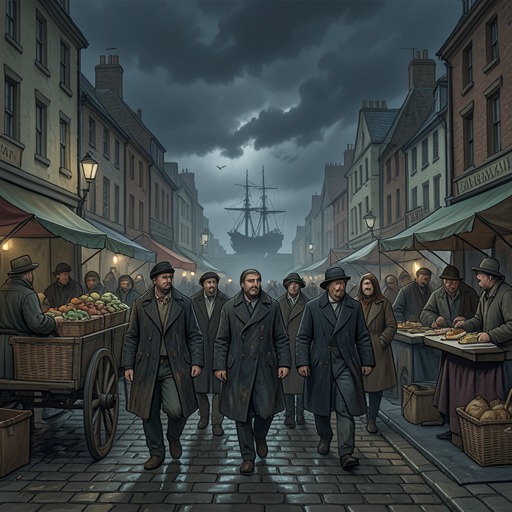
The harbor reaches the family first through its odors and sounds. A fragrance over the water combines salt, fruit, burned wood, algae, and sand; Paolo calls it the smell of dry land, while Ignazio takes it as Palermo’s perfume. As they near the active harbor, that impression gives way to the acrid stench of dung, sweat, pitch, and stagnant water. The city’s abundance is not presented as a polished abstraction: its commercial vitality is crowded, physical, and mixed with the refuse of port life.
Palermo’s prosperity is also part of a wider political transformation. Revolutionary upheaval and war have disrupted Mediterranean shipping. After the French and British renew hostilities, Napoleon attacks ships crossing the sea, making merchant vessels less safe and pushing the British, formerly masters of the sea, into a more precarious position. Palermo and Sicily become a free port beyond French influence and, above all, a central Mediterranean marketplace. Merchants and sailors arrive from across Europe; French spices come through northern Italian ports, British goods through Malta, and cargoes also come from Turkey, Egypt, Tunisia, and Spain. The city that Paolo chooses is therefore being remade by the same political forces that have unsettled the region.
What the Move Leaves Behind
The brothers do not notice that Giuseppina’s eyes remain on the open sea, as though she can still see Bagnara. Her attention gives the arrival a different meaning from Ignazio’s. He looks toward the city and feels its beauty; she is still oriented toward what has receded. In memory, Mattia remains close: more than a sister-in-law, she has been Giuseppina’s friend, her rock, and the voice that guided her through the difficult first months of her marriage to Paolo.
Giuseppina had hoped that Barbaro and Mattia would follow the family to Palermo, but that hope was soon extinguished. Paolo Barbaro chooses to stay in Bagnara and travel back and forth to Palermo, maintaining trade with the north and another safe harbor. He says he needs a woman to look after his house and children. Giuseppina suspects that he also wants to keep his wife away from her brothers, particularly from Mattia’s close bond with Ignazio. The Florios’ relocation therefore does not draw the whole network of kin and business partners together. It separates households and preserves different centers of loyalty even as commerce links them to the same city.
Consequences and Significance
In Palermo, the Florios’ business develops beyond the original store. They rent cool, guarded rooms behind the customs offices within the Palazzo Steri property, using the warehouse to hold spices in transit or awaiting sale. Because import tariffs are paid only when goods enter Palermo, the arrangement lets wholesalers pay rent on storage rather than incur customs charges before the goods are needed. The stockroom on Via dei Materassai becomes too small. Their supplies include Indian spices obtained through the British and goods from French colonies bought in Livorno and sold around the Tyrrhenian Sea, alongside high-quality products from across the Mediterranean. The family is not yet as wealthy as the Canzoneris, but its position has advanced rapidly.
That expansion belongs to a longer pattern in which the city’s markets and the Florios’ fortunes change together. The book places their arrival amid the revolutionary upheavals that began sweeping Italy from 1796, the Neapolitan revolt of 1799, and the Bourbons’ refuge in Palermo. Later political unrest continues to unsettle the island: the 1820 revolt restores the Sicilian Parliament and the constitution for a time, before divisions among Sicilian cities help the Bourbons suppress the movement. Commercial opportunity in Palermo is not a sign of political stability; it develops amid shifting powers, rebellion, and repression.
The migration’s mixed outcome is visible in the family’s later life as well as in its arrival. Giuseppina’s separation from Bagnara does not erase her attachment to the people left there, while the sons’ commercial world becomes increasingly bound to Palermo’s exchanges. Years later, a can of tuna in brine from the Arenella fishery evokes Vincenzo’s childhood kitchen and an earthenware pot sealed with wax, joining the family’s later enterprise to remembered domestic life. The move is consequential because it makes both transformations possible: the Florios’ rise through Palermo’s trade and the private dislocations that prosperity cannot repair.